

Sauna Buyer’s Guide: How to Choose the Right Sauna for Your Home
Buying a sauna is less about choosing a product and more about choosing a habit you will still have in five years. The difference between a sauna you use daily and one that quietly becomes storage usually comes down to decisions made before you order. Our range of home saunas covers three very different heat experiences, and the right one depends on your space, your power supply, and how you actually plan to use it. Here is what to weigh up, in the order that matters.
Key Takeaways
-
Heat type determines how a session feels, so choose it based on how you want to use the sauna rather than on specifications alone.
-
Size your sauna for how people sit, not just how many fit, because bench depth and ceiling height affect comfort more than floor area.
-
Electrical requirements are the most commonly overlooked cost, and some saunas need a dedicated circuit installed by a licensed electrician.
-
Build quality, warranty, and after-sales support matter more than features when you are buying something designed to last a decade.
Start With How You Want the Heat to Feel
Every other decision follows from this one. The three heat types are not better or worse than each other; they are different experiences, and people tend to strongly prefer one.
Traditional Finnish saunas
A traditional sauna uses an electric heater topped with stones to warm the air inside the cabin, typically between 70°C and 90°C. The heat stays dry until you ladle water over the stones, releasing a burst of steam that raises humidity and makes the heat feel much more intense. Sessions usually run 10 to 20 minutes.
This is the classic experience, and it suits people who want heat they can feel immediately and control themselves. The EverGlow® Traditional Sauna sits in this category. The trade-off is heat-up time, since most cabins need 30 to 45 minutes to reach temperature, though the EverGlow® gets there in under 30 minutes.
Infrared saunas
Infrared saunas work differently. Carbon or ceramic panels emit radiant heat that your body absorbs directly, so the air itself stays much cooler, usually between 45°C and 60°C. The EverGlow® Infrared Sauna sits slightly above that range at 65°C, which gives you a bit more intensity without losing the gentler feel. You still sweat heavily, but the environment feels far less confronting.
Because the air is cooler, sessions tend to run longer at 30 to 45 minutes, which suits people who want to read, listen to something, or simply sit for a while. Heat-up time is shorter, and power consumption is lower. The EverGlow® Infrared Sauna is built around this gentler, longer-session approach. If you have found traditional saunas overwhelming, this is usually the answer.
Portable steam saunas
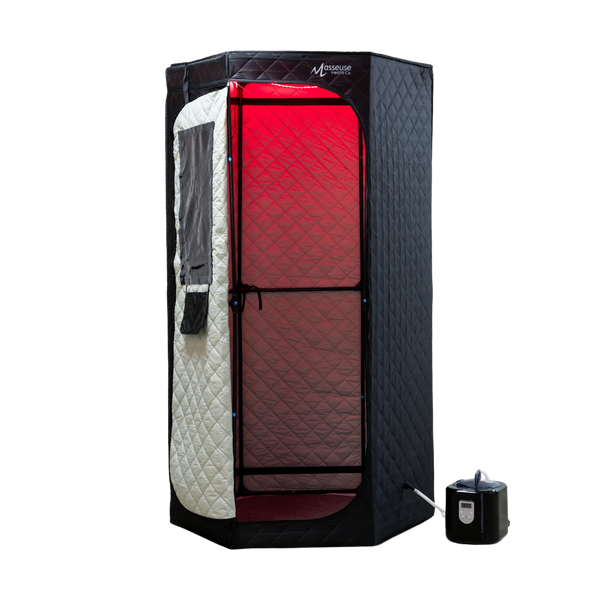
A portable steam sauna uses a fabric enclosure and a small steam generator, with the enclosure surrounding you. The ThermaPod® Portable Steam Sauna works this way. It is the most affordable entry point, packs away when not in use, and runs from a standard power outlet with no installation required.
It suits apartments, renters, and anyone who wants to establish the habit before committing to a fixed cabin. What you give up is the immersive feel of a full cabin and the ability to have your head in the heat.
Sizing a Sauna for Your Household
Capacity ratings tell you how many people fit, not how many people are comfortable. Think about how you will actually sit.
-
One to two people: suits solo users and couples. Look for at least one bench long enough to lie down on if you prefer reclining.
-
Two to three people: the most practical size for most households, leaving room to stretch out without heating unnecessary space.
-
Four or more: worth it if you genuinely host, but larger cabins cost more to run and take longer to warm up.
-
Ceiling height: heat rises, so a cabin with too much headroom wastes energy warming air you are not sitting in.
-
Bench depth: anything under 45 cm makes cross-legged sitting or lying down uncomfortable.
-
Access clearances: measure your doorways, hallway corners, and gate widths before making a purchase, not after.
That last point causes more delivery problems than anything else. A cabin that fits your backyard perfectly is no use if it cannot get past the side gate.
The Question Most Buyers Forget: What Will It Plug Into?
This is the single biggest hidden cost in a sauna purchase and the detail most buyers' guides skip entirely. Saunas vary enormously in what they demand from your home's electrical system.
-
Standard 10 amp outlet: portable steam saunas and most smaller infrared units plug straight into a normal household socket with no electrical work.
-
Dedicated circuit: many larger infrared cabins and smaller traditional heaters need their own circuit run to the sauna, which means electrical installation work must be carried out by a licensed electrician.
-
Hardwired connection: many traditional electric sauna heaters require a fixed electrical connection rather than plugging into a standard household outlet.
-
Single-phase or three-phase power: traditional sauna heaters may support single-phase, three-phase, or both, depending on the model. Three-phase power is not limited to commercial or very large saunas.
In Australia, any new circuit or hardwired connection must be installed by a licensed electrician in line with AS/NZS 3000 wiring rules. Budget for that quote before you commit. Check the kilowatt rating on the specification sheet and send it to an electrician, because a switchboard that is already near capacity can turn a simple installation into a much larger job.
Where It Will Actually Be Placed
Saunas are heavy, and a fully assembled cabin with occupants inside can weigh several hundred kilograms. Indoors, that means checking floor loading on upper storeys. Outdoors, it means a level, stable base such as a concrete slab, pavers, or properly rated decking. An uneven base puts stress on panel joints and doors over time.
Consider water as well. People come out of a sauna wet, so think about where that water goes and whether the surface underfoot becomes slippery.
If the sauna is going outdoors, it needs protection from direct weather regardless of what the timber is rated for. Sustained sun and rain will shorten the life of both the timber and the electronics. A covered pergola, eave, or dedicated roof makes a real difference.
Finally, check the paperwork side. Freestanding outdoor structures can trigger council setback requirements in some areas, and apartment or townhouse owners may need body corporate approval. A quick phone call early is far cheaper than moving a cabin later.
What a Home Sauna Costs to Run
Running cost comes down to three variables: the unit's power rating in kilowatts, how long it runs, and your electricity tariff.
Infrared saunas typically draw less power and heat up faster, so a session costs less. Traditional saunas draw more and need a longer warm-up before you get in, which means the cost per session is higher even if the session itself is shorter. Portable steam units sit lowest of all.
The practical way to compare is to multiply the kilowatt rating by the total hours of operation, including heat-up, then multiply by your per-kilowatt-hour rate. Do that maths for how often you realistically plan to use it. If you are building a daily recovery routine, a difference of a few cents per session compounds noticeably over a year. If you plan on two or three sessions a week, it barely registers.
Materials and Build Quality That Age Well
Timber does most of the work here. Canadian hemlock is stable, low-odour, and holds up well in heat. Western red cedar resists moisture naturally and has a distinctive aroma many people associate with the experience. Thermally modified timber is treated with heat rather than chemicals to improve dimensional stability. All perform well, so the more useful questions are about grade and construction: is the timber knot-free where you sit, are the panels properly tongue and groove, and is the cabin insulated?
Insulation is often overlooked. A poorly insulated cabin loses heat continuously, which raises running costs and makes it harder to maintain a comfortable temperature. Look for well-fitted panels, quality seals, and construction designed to retain heat efficiently.
Good materials also make ownership easier. A well-built cabin requires straightforward sauna maintenance and care rather than constant attention, and timber that is properly finished will not warp or split under normal use.
Features That Earn Their Place
Feature lists get long quickly. These are the ones that genuinely change the experience:
-
Digital controls with a timer: lets you pre-heat so the sauna is ready when you are, which is the difference between using it and skipping it.
-
Chromotherapy lighting: colour light therapy changes the atmosphere of a session considerably and makes it easier to return to.
-
Bluetooth audio: minor on paper, but it shapes how long people stay in.
-
Ergonomic backrests: comfort determines session length more than temperature does.
Delivery, Assembly and What Happens Afterwards
Ask how the sauna arrives and who puts it together. Some units are genuinely straightforward self-assembly. Larger cabins are better handled with white glove delivery, where a team brings it in, assembles it and removes the packaging.
Then ask what happens in year three. Warranty length matters, but so does whether the supplier holds spare parts, whether you can reach a real person when a control panel plays up, and whether the company is likely to still be trading. This industry has seen brands disappear and leave customers without support, so trading history is a legitimate part of the decision.
Making the Right Call
Work through it in this order. Decide how you want the heat to feel, size it for how you will sit rather than how many fit, confirm what your switchboard can handle, and check that the space and access work. Once those four considerations are settled, the shortlist usually narrows to one or two options, and the remaining choice is about materials, features, and budget.
If you are still weighing up heat types, browse the full range of home saunas to compare specifications side by side, or start smaller with the ThermaPod® Portable Steam Sauna if you want to build the habit first.
You can also call the team on 1300 888 669. It is a purchase worth making right the first time.
Explore our products


Explore Editorial Content


